
Upcoming & Past Events
PREP hosts monthly seminars during the academic term as well as occasional larger events that seek to catalyze critical conversations about contemporary approaches to peacebuilding
AI for the SDGs
The “AI for the SDGs” event featured Professor Arthur G.O. Mutambara in a conversation about how artificial intelligence can be used to advance the UN Sustainable Development Goals. The discussion focused on the idea that AI should not just be treated as a technical tool, but as a force that can drive human development, reduce poverty, improve access to education and healthcare, strengthen agriculture and infrastructure, and support more inclusive economic growth. Professor Mutambara emphasized that sustainable development must ultimately improve people’s lives. He argued that AI should be used to address urgent global problems, especially poverty, hunger, energy access, and inequality. At the same time, he warned that AI also carries serious risks, including bias, job displacement, surveillance, militarization, data colonialism, and widening global inequality.
A major theme of the event was the need for the Global South to not only consume AI technologies but also help design, govern, and own them. Mutambara stressed that effective AI adoption requires strong digital infrastructure, energy access, local data sovereignty, diverse teams, and intentional governance. Without these foundations, AI could deepen existing inequalities instead of helping solve them. The event was both hopeful and cautionary. It highlighted AI’s enormous potential to accelerate progress toward the SDGs, while also making clear that this will require leadership, accountability, inclusive design, and a commitment to collective success rather than individual or corporate gain.
Mourning and Activism: the case of the Triangle Shirtwaist Factory Fire
The lecture, “Mourning and Activism: the case of the Triangle Shirtwaist Factory Fire,” led by Elik Elhanan, explored how collective grief can become a powerful driver of political action. While centered on the 1911 Triangle Shirtwaist Factory Fire, the talk went much deeper connecting the event to broader themes of labor history in New York, Jewish immigrant organizing, and the political role of mourning. Elhanan examined how the fire, an entirely preventable tragedy that killed 146 workers, mostly young immigrant women, sparked massive public outrage and mobilization. He emphasized that what made this moment transformative was not just the scale of the tragedy, but how grief was made visible in the public sphere, how responsibility was clearly attributed to systemic failures like unsafe labor conditions and unchecked capitalism, and how this ultimately led to real institutional change, including labor protections and union recognition.
A key part of the lecture focused on how mourning itself became political. Elhanan highlighted how immigrant communities, particularly Yiddish-speaking Jewish workers, developed their own language and practices of collective mourning that challenged dominant narratives and demanded recognition. These mourning practices, especially large, silent protest processions, created a powerful, unified public response that helped translate grief into sustained activism.
He then connected these ideas to his own work with Combatants for Peace, reflecting on how similar questions arise today: how can shared grief be mobilized into meaningful political action, and why does it sometimes fail to translate into sustained engagement? Drawing on his experience with the joint Israeli Palestinian Memorial Day ceremony, he discussed both the power and the limitations of creating spaces for shared mourning in ongoing conflict. The lecture moved between past and present, using the Triangle Factory Fire as a case study to explore larger questions about memory, visibility, responsibility, and the challenges of turning emotional response into lasting political change.
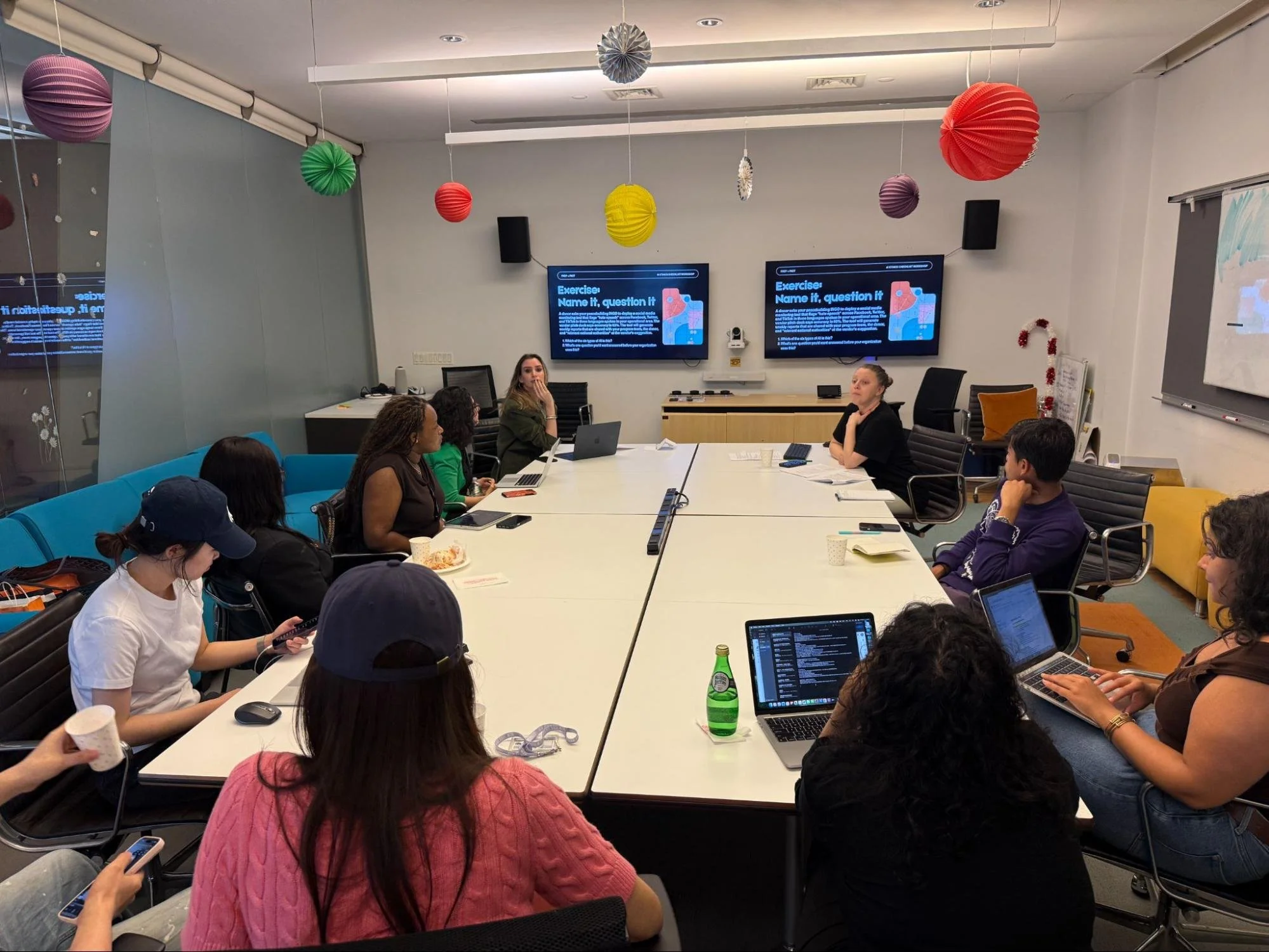
Skill Building Event: AI Ethics Checklist for Peacebuilding Practitioners
The “Skill Building Event: AI Ethics Checklist for Peacebuilding Practitioners” was a practical, skills-based session focused on helping students think critically about the role of AI in peacebuilding work. Led by Katerina Siira and Marine Ragnat, the event introduced a framework designed specifically for practitioners, offering a tool that can be used in the field when encountering AI-driven projects, whether in implementation, advisory roles, or when assessing whether AI is appropriate in a given context.
The session went beyond theory and focused on real-world application. Participants engaged with case examples and practiced asking key questions around power dynamics, data ownership, consent, and accountability. Rather than presenting AI as purely beneficial or harmful, the discussion encouraged a more nuanced approach, thinking through both the risks and potential opportunities of AI in peacebuilding contexts. The event aimed to make AI ethics more accessible and practical, giving students a clearer sense of how these tools are already shaping the field and how they might be used responsibly moving forward.
Peace in Practice: PREP and PACT Welcome Night
The “Peace in Practice: PREP and PACT Welcome Night” was a casual, low-key event designed to welcome students back after winter break and create space for connection at the start of the semester. It brought together both returning members and new students who had just joined in the spring, offering an easy and welcoming environment to meet one another. The event was intentionally informal, more of a happy hour-style gathering than a structured program. Students had the chance to grab a drink, chat, and get to know others involved in PREP and PACT, as well as learn more about opportunities for the semester ahead. It also gave new members a chance to integrate into the community in a way that felt relaxed and approachable. It was a really nice, easygoing evening focused on building community, less about formal introductions and more about simply spending time together, meeting new people, and reconnecting after the break.
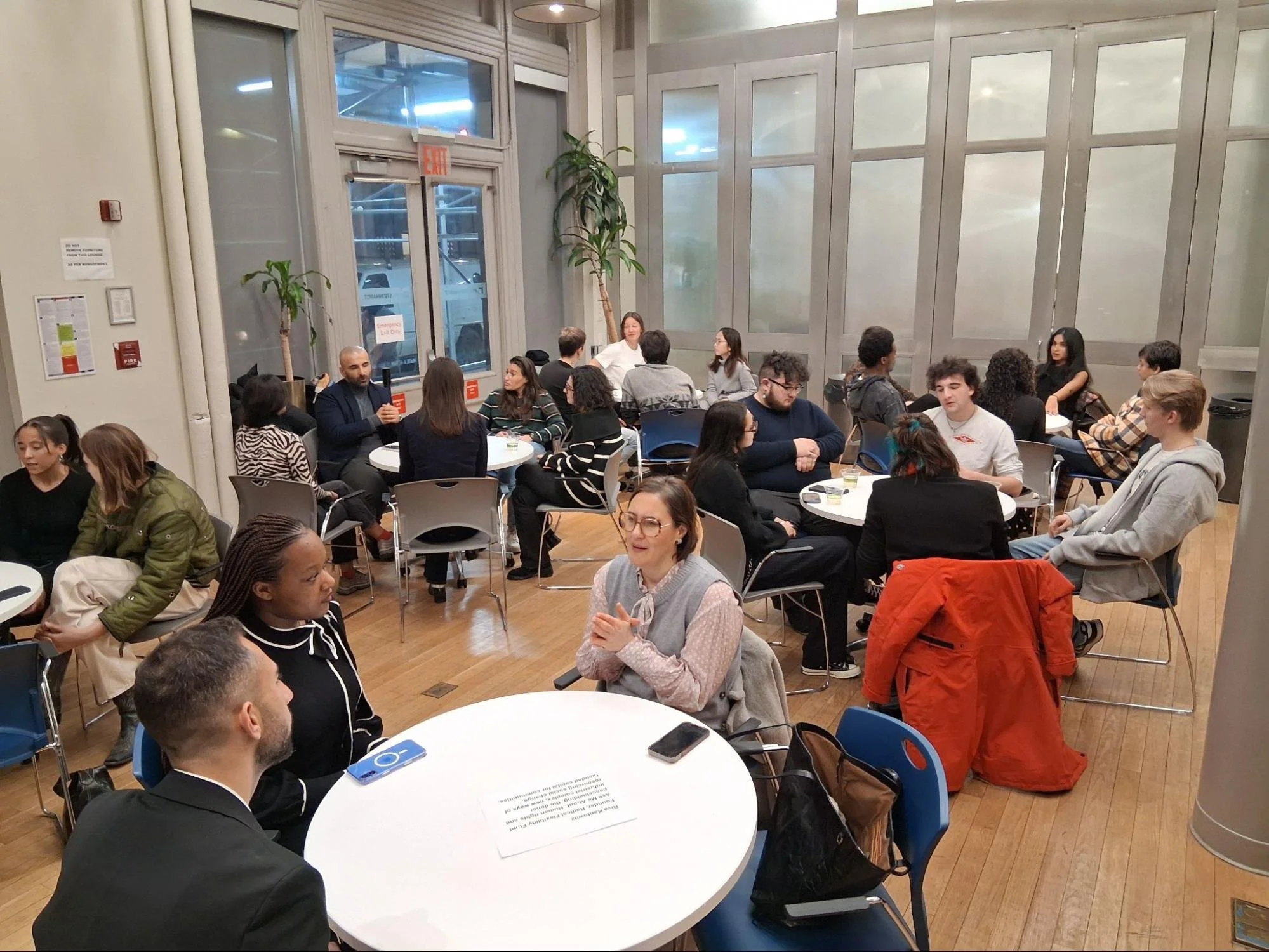
Mingle & Jingle: Holiday Networking Night
PREP’s 2nd annual “Mingle & Jingle: Holiday Networking Night” brought together two dozen students for an evening of meaningful, low-pressure engagement with an incredible group of professionals, including Kirsi Joenpolvi, Djeyhoun Ostowar, Riva Kantowitz, Céline Monnier, Vijayta Narang, and Michelle Rivera. It was truly a great way to wrap up a semester full of dynamic events from the NYU Peace and Research Education Program team!
Designed as a more relaxed alternative to traditional networking, the event used a rotating, table-based format that allowed students to move between conversations, connect in smaller groups, and engage more directly with practitioners across the peacebuilding and international affairs fields. This setup made it easier to ask questions, hear about real career paths, and get a clearer sense of what working in the field actually looks like in practice. The professionals represented a wide range of roles, from UN agencies to NGOs and policy-focused organizations, offering students exposure to diverse career trajectories. Conversations focused on everything from navigating internships and job searches to translating academic experience into practical work, while also creating space for honest discussions about challenges, pivots, and lessons learned.
This fun, cheery end-of-semester event felt less like traditional networking and more like a series of meaningful one-on-one or small group conversations. It was a valuable opportunity for students to build connections and head into the next semester with a stronger sense of direction and possibility. Many thanks to the NYU Peace and Conflict Transformation (PaCT) club for co-sponsoring, and to Océane Hooks-Camilleri for adding a remote element to an otherwise in-person gathering.
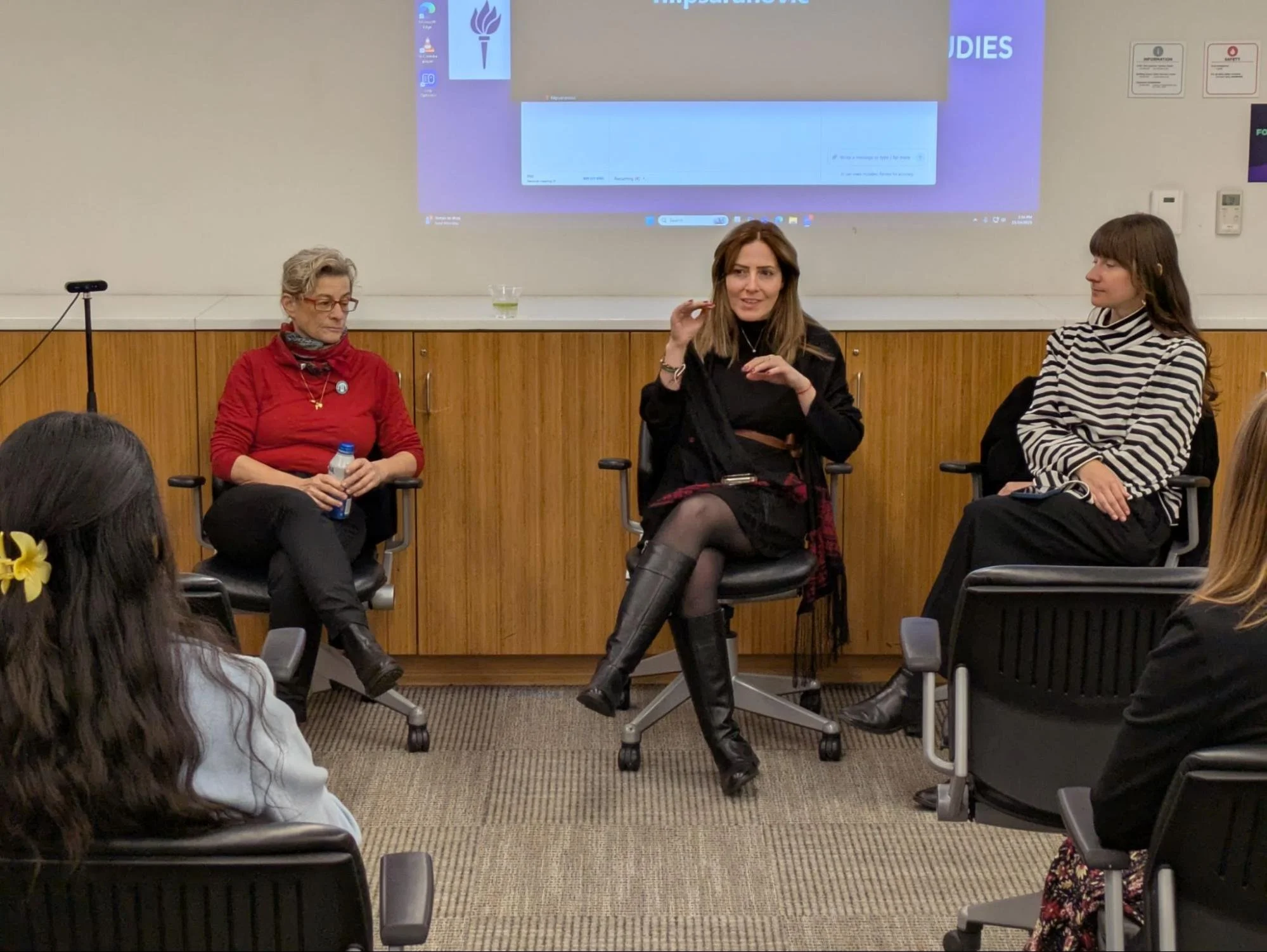
Peace in Progress: Women's Voices on Justice and Repair, A Conversation with Israeli & Palestinian Peacemakers
The event, “Peace in Progress: Women's Voices on Justice and Repair, A Conversation with Israeli & Palestinian Peacemakers,” was a roundtable-style discussion that created space for an honest and deeply human conversation about peacebuilding in the current moment. Hosted in collaboration with Combatants for Peace, the session brought together two speakers, Noa Harrell and Nimala Kharoufeh, who shared their lived experiences working across conflict lines and their ongoing efforts to support communities, particularly in Gaza, amid continued violence and instability.
The structure of the event was intentionally simple and conversational. After a brief welcome and introduction, the speakers shared their personal stories, how they each came to peacebuilding work, and what it means to engage in nonviolent co-resistance in a context shaped by trauma, loss, and political tension. Their perspectives were especially powerful because they came from different lived experiences, one Israeli and one Palestinian, yet were grounded in a shared commitment to dialogue, accountability, and collective healing. The core of the event was an open Q&A discussion, which allowed for a more honest and unscripted exchange. Rather than a formal presentation, the conversation centered on real-time questions about what their work actually looks like right now, especially in relation to Gaza. They spoke about the challenges of continuing peacebuilding efforts during ongoing conflict, the emotional toll of the work, and the importance of maintaining relationships and dialogue even in moments of deep grief and division.
A major theme throughout was the idea of choosing repair over revenge, and how that choice is not abstract, but something that requires constant effort, especially in a context where communities are experiencing loss and fear. They also emphasized the role of grassroots movements like Combatants for Peace in creating alternative pathways forward, rooted in solidarity, nonviolence, and shared humanity. The event concluded with closing remarks and informal conversation, giving participants space to continue engaging with the speakers and reflect on what they had heard. Overall, the discussion stood out for how honest and grounded it felt, less about presenting solutions, and more about sharing what it actually looks like to do peacebuilding work in real time, in the middle of ongoing conflict.
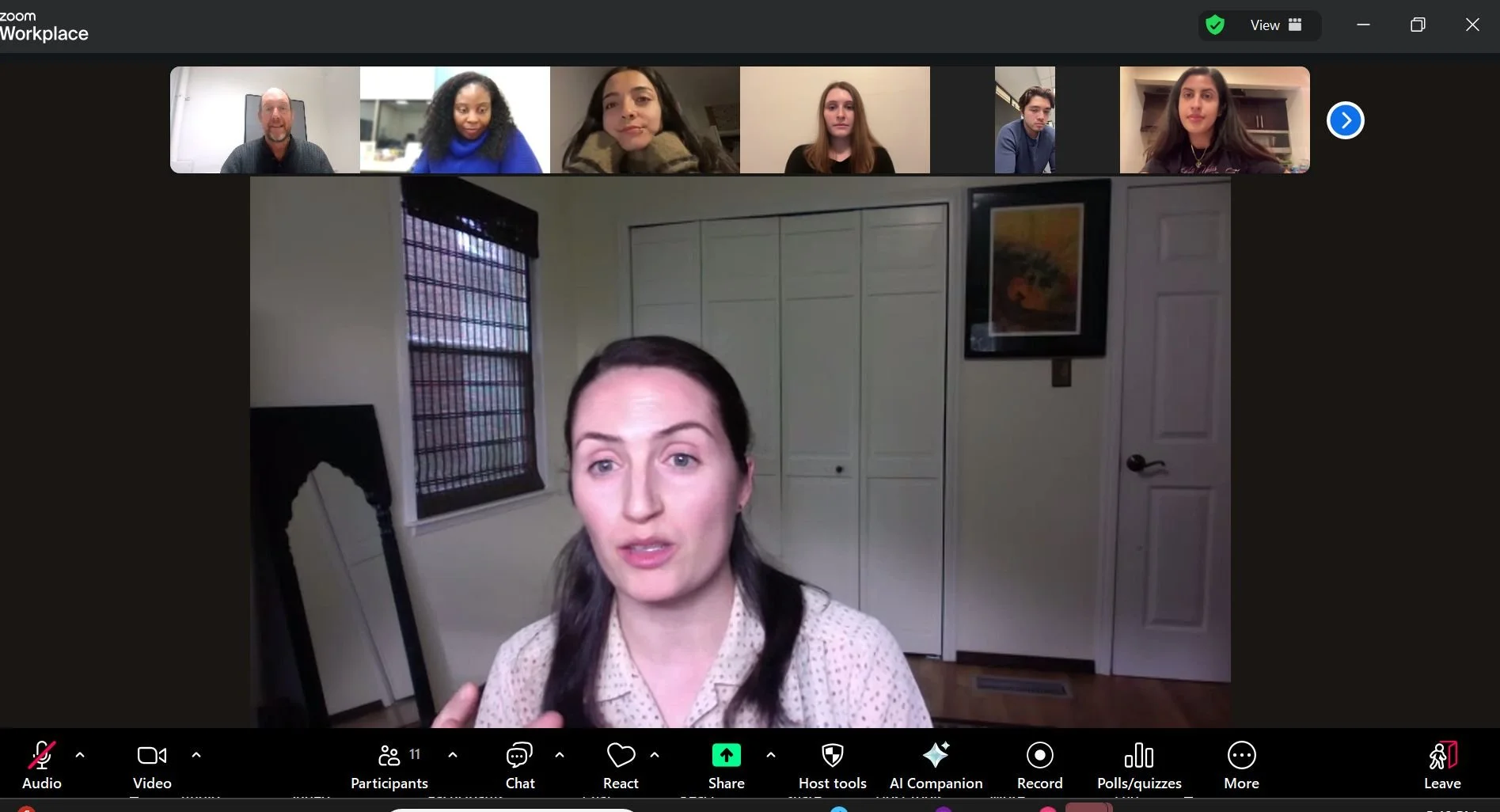
Exploring What’s Next: Career Transitions Through a Systems Lens
Peacebuilding concentration alumni at the NYU SPS Center for Global Affairs continue to give back in meaningful ways to the current student community. Recently, the NYU Peace Research and Education Program co-hosted an event with the NYU Peace and Conflict Transformation (PaCT) club featuring Océane Hooks-Camilleri and Love Odih Kumuyi, who led the session, “Exploring What’s Next: Career Transitions Through a Systems Lens.” The event was designed as a reflective, virtual community space to support students navigating the uncertainty of post-graduate transitions. Rather than treating career decisions as purely individual choices, the session encouraged participants to think more holistically, situating their skills, experiences, and aspirations within a broader system shaped by networks, institutions, expectations, and structural constraints.
Using systems thinking as a light framework, Océane and Love challenged students to move beyond traditional career paths or well-worn employers and instead consider how their roles might fit within the larger peacebuilding ecosystem. The session balanced reflection and interaction, beginning with a group check-in that surfaced a range of emotions about life after graduation, from excitement to uncertainty, before moving into breakout discussions. In smaller groups, participants mapped their own “career systems,” identifying key influences such as mentors, financial pressures, opportunities, and personal motivations, and examining how these elements are interconnected. By “zooming in and out,” students were able to recognize patterns, gaps, and new insights about how they approach their next steps. The session concluded with a full group discussion and reflections, emphasizing curiosity over certainty and awareness over immediate decision-making. The event offered a refreshing shift toward more optimistic, capacity-focused thinking. Rather than centering fear or perceived deficits, it encouraged students to better understand the systems shaping their paths and to approach their transitions with greater clarity, confidence, and a broader sense of possibility.
Reflections From The Field
The “ Reflections from the Field” event was part of an extraordinary month of programming at the NYU Peace Research and Education Program. Bringing together both students and practitioners, the event created a space to reflect on the unprecedented shifts currently reshaping the peacebuilding field. Against a backdrop of major changes in global funding structures, political dynamics, and institutional support systems, the discussion focused on how peacebuilding actors are being pushed to rethink traditional approaches. As highlighted throughout the event, these seismic shifts, particularly in the United States and across the Global North, are driving new forms of innovation, from alternative financing models to the increasing use of technology, including artificial intelligence, as tools to address power imbalances and adapt to evolving challenges.
The event featured two complementary panels. A student panel, including Luna Tejedor Amblar, Ashlie Oxford, and Carolina de Almeida Pernambuco Moron, shared reflections from their summer consultancies with peacebuilding organizations around the world. Their insights highlighted how emerging practitioners are navigating disruption and identifying new pathways for impact. This was followed by a practitioner panel with Vijayta Narang, Bernie Shaw, and Jirandy Martinez, who discussed how their organizations are actively adapting to these global shifts through innovative strategies and approaches. A central theme that emerged across both panels was the growing emphasis on re-centering local voices. As traditional systems face increasing strain, communities themselves are playing a more prominent role in defining and driving peacebuilding efforts. The conversation underscored that while the current moment presents significant challenges, it also opens up space for more inclusive, adaptive, and locally grounded approaches to peace. The event served as both a reflection on a rapidly changing field and a forward-looking discussion on how peacebuilding can evolve in response, highlighting innovation, resilience, and the importance of reimagining pathways to peace.

Film Screening: There is Another Way
Join us for a powerful screening of There Is Another Way. In the midst of darkness, we discover who we truly are. There is Another Way tells the story of a group of visionaries who refuse to surrender to violence and injustice, and in doing so show that another path is possible - for them, for us, and for all humanity. As we are all faced with essential questions about who we are, will we choose collective liberation, where the needs, rights, and safety of all are prioritized - in which our humanity comes first, knowing that no one is free until everyone is free.
Combatants for Peace, nominated for two Nobel Peace Prizes, is an extraordinary bi-national group of former enemy combatants - Israelis and Palestinians - working together during an ongoing armed conflict. Confronted with the devastation and escalating violence of October 7th and the war in Gaza, the very core of the movement faces great challenges in showing that there is another way. The first question they must answer relates to their own beliefs...is this possible?
🗓 Wednesday, April 30
🕔 5:00 – 7:00 PM
📍 Meyer Hall, Room 121, 6 Washington Pl.
Followed by a panel discussion with Director & Producer Stephen Apkon. Don’t miss this important conversation about hope, humanity, and the power of choosing a different path.
🔗 Register now
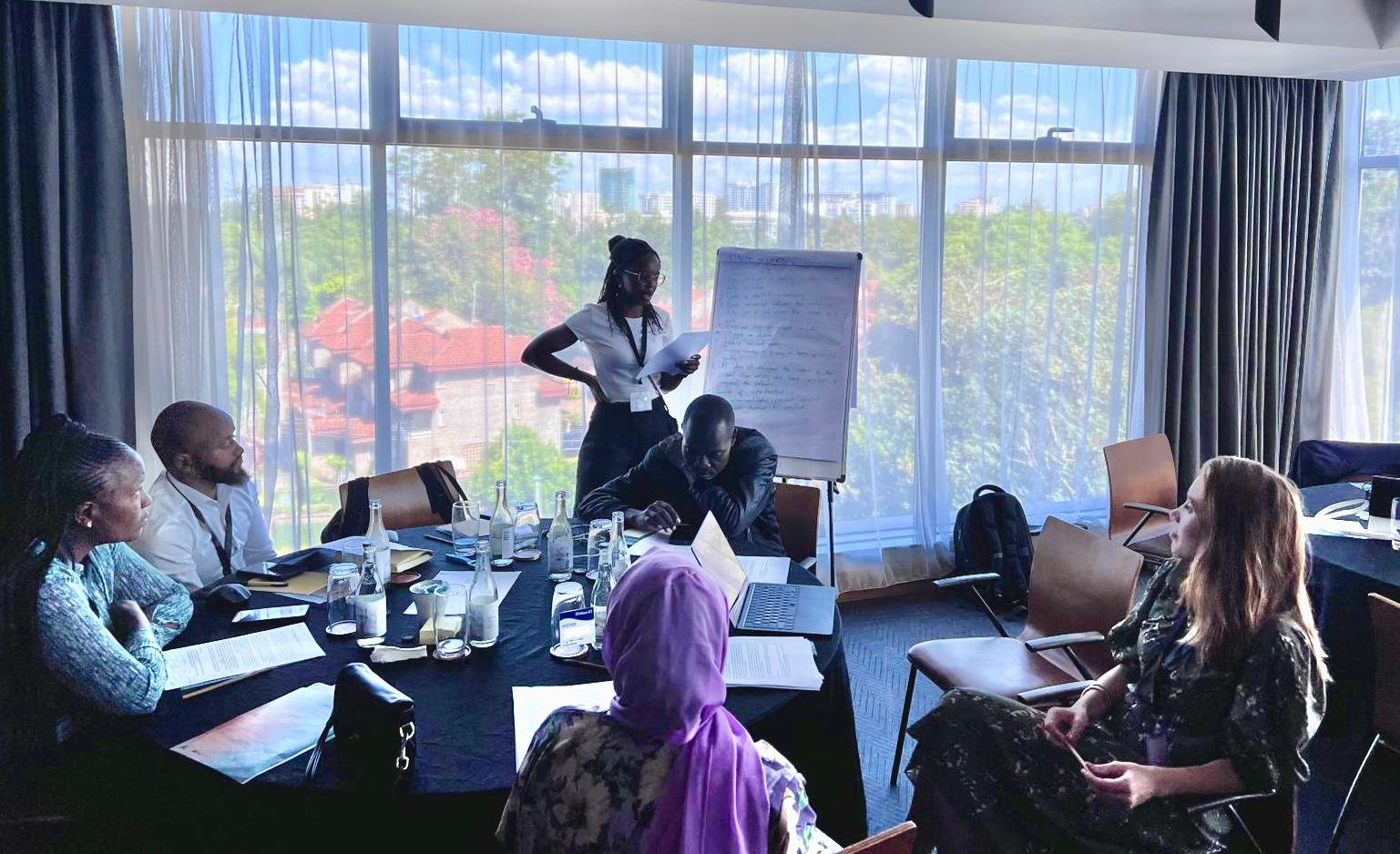
Digital Sovereignty: Mapping Kenya's AI Landscape
NYU Peace Research and Education Program, University of Nairobi and Portulans Institute brought together policymakers, technologists, academics and civil society to tackle a critical question: How can Kenya build and maintain AI sovereignty within a rapidly evolving global and national AI landscape?
What we did:
Mapped key power actors in Kenya's AI ecosystem
Convened cross-sector experts from Ushahidi, Jiji Health, and University of Nairobi
Analyzed real-world AI dilemmas in security, health, agriculture, and fintech
Key insights:
AI sovereignty = data sovereignty
Building locally-relevant solutions creates true resilience
Community voices must be central in governance frameworks
Educational capacity building and innovative financing are essential for long-term independence
This workshop coincides with Kenya's new National AI Strategy 2025-2030, offering timely pathways for implementation that reflect Kenyan priorities and values.
Workshop facilitated by Katerina Siira, Marine Ragnet, Ben Mkalama and Florence Muindi with panelists Angela Oduor Lungati, Kilemi Thambura and Timothy Waema, Ph.D
Click below to learn more about the workshop findings
Young Women Mobilizing for Peace: A Night of Solidarity with Sudan
On 14th March, NYU PREP and NALAFEM gathered for “Young Women Mobilizing for Peace: A Night of Solidarity with Sudan” — a powerful moment of sisterhood, resistance, and collective action.
The event convened over 60 participants (both in-person and virtual) from 15 countries to reflect, connect, and reaffirm our shared commitment to feminist peace and justice across Africa. Together, the community echoed the call forcross-border solidarity for Sudan and strengthened the feminist movements that center the leadership of young women peacebuilders.
The side event spotlighted the transformative power of intergenerational co-leadership in peace building. They discussed:
The role of young women in peacebuilding and governance
First-hand experiences from Sudanese young feminist leaders
The impact of the I AM NALA Fellowship in shaping the next generation of leaders
The fight for peace, justice, and women’s leadership in Sudan continues — louder, stronger, together.
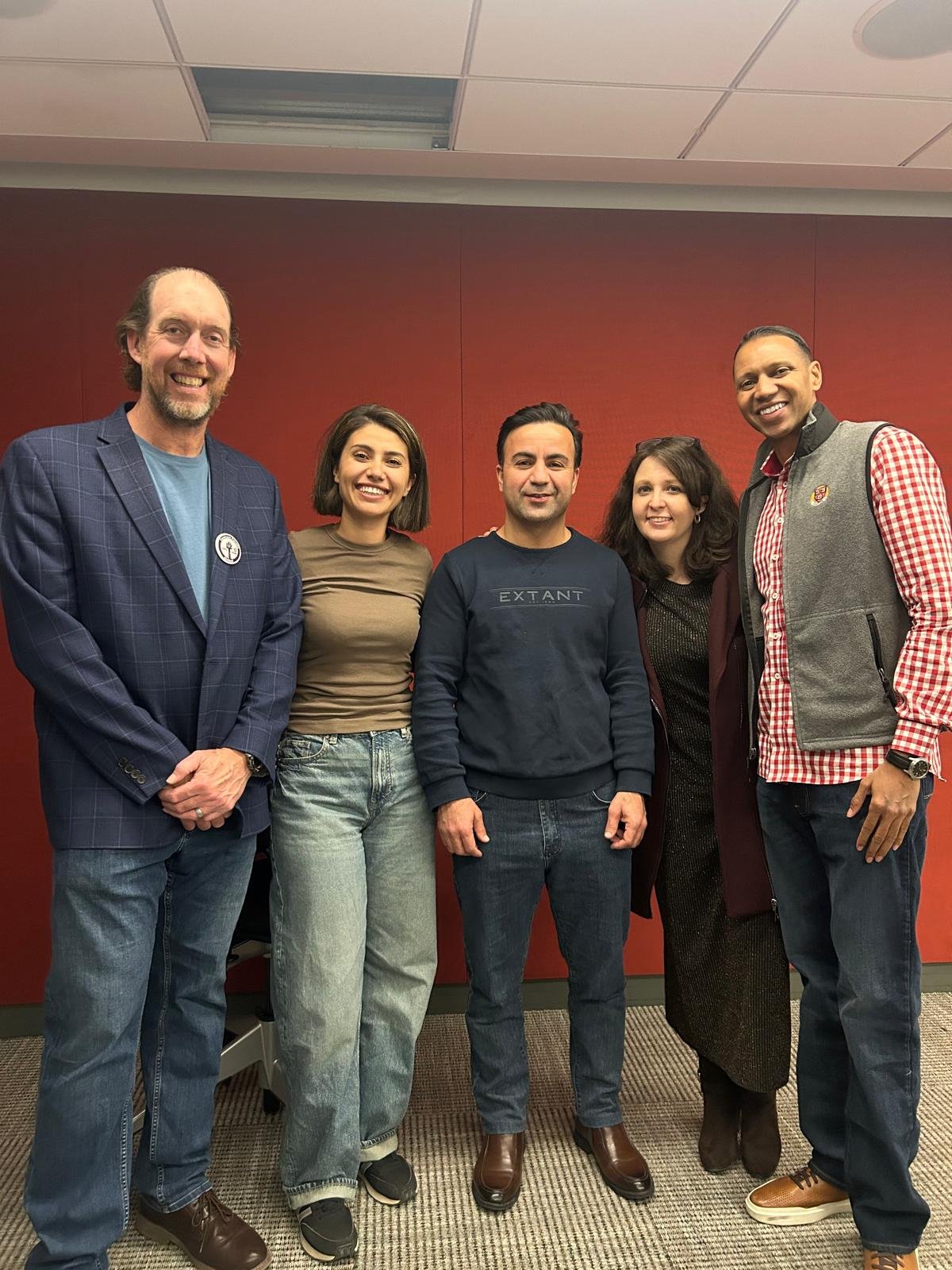
Film Screening and Discussion: Untold Stories
NYU PREP is pleased to reflect on the successful screening of Untold Stories, a powerful documentary directed by Dida Faridoon and presented in collaboration with Ideas Beyond Borders and the Kurdistan Information Network, with support from the Wikimedia Foundation Equity Knowledge Fund.
The screening offered a poignant exploration of Iraq’s marginalized communities, including the Kakayi, Feyli Kurds, Armenians, Assyrians, Chaldeans, Syriacs, Sabean-Mandeans, and Jews. Through compelling narratives, the documentary shed light on their histories, struggles, and resilience, fostering a deeper understanding of identity, migration, and democracy in Iraq.
Following the screening, attendees engaged in a thought-provoking Q&A session with Director Dida Faridoon, where powerful insights were shared about storytelling as a means of amplifying marginalized voices.
We extend our gratitude to everyone who participated in this impactful event, which highlighted the importance of preserving cultural narratives and promoting inclusivity through dialogue.

BRIDGES TO PEACE AND DEVELOPMENT: A HOLIDAY DIALOGUE ACROSS FIELDS
On December 10, 2024, PREP brought together CGA students and experts from the fields of peacebuilding and international development for a rich afternoon of conversation and networking.
Our esteemed panelists included Jonathan Cantres (Bard Early College High School), Sarah Gibbs (Center for Reproductive Rights), Marta Bautista Forcada (NYU Center on International Cooperation), Johan Fredborn Larsson (UNDP Conflict Prevention, Peacebuilding and Responsive Institutions Crisis Bureau), Katerina Siira (NYU Peace Research and Education Program), and Joy Galvez (UN Food and Agriculture Organization). Their diverse experiences provided invaluable insights into their work within international development, the United Nations, and broader peacebuilding initiatives.
The event's format encouraged interactive small-group discussions, fostering meaningful conversations between students and professionals. As Professor Hill remarked, "I felt such positive energy from all of you by the end of the event that I was convinced we may have just discovered the secret sauce for future career events: lots of interactive small-group conversations and zero time listening to a panel discussion."
We are grateful to all participants and guests for their engagement, thoughtful questions, and career insights. Special thanks to the DHA Club, PREP, and PaCT for co-hosting the event and making it such a memorable success. As we close out the semester, we look forward to continuing these important conversations and building stronger bridges between academia and practice in the new year.

Flipping the Script: The Power of Nonviolent Action
"Flipping the Script: The Power of Nonviolent Action,” featured two insightful panel discussions followed by a reception. The first panel showcased Master’s students from the Workshop in Applied Peacebuilding, who shared reflections from their summer consultancies in Sierra Leone, Jordan, and Libya. Their experiences provided valuable insights into the practical challenges and successes of peacebuilding efforts in diverse contexts.
The second panel brought together activists and practitioners from Combatants for Peace, Waging Nonviolence, and policy academics, who engaged in a compelling discussion about the role of strategic nonviolent action in driving social and political change. The panelists emphasized themes of adaptability, collaboration, and resilience in peacebuilding efforts.
We extend our sincere gratitude to all participants and contributors for fostering such a rich and meaningful dialogue. This event underscored the power of nonviolent action in creating lasting peace and strengthened our collective commitment to peacebuilding efforts worldwide.
Evolving New Perspectives on Decolonizing Peacebuilding: A Conversation with Youssef Mahmoud
PREP’s last seminar of its year-long series on Turning Decolonization Rhetoric into Action centered around a conversation between students and Dr. Youssef Mahmoud, Senior Adviser at the International Peace Institute. Students posed thoughtful questions on the meanings and impacts of colonization, while Dr. Mahmoud candidly shared his experiences on the concept of decolonization and its practice in the peacebuilding field.
Dr. Mahmoud began by asking students what colonization meant to them personally, exploring its effects on land, values, institutions, language, ideas, education, history and more in their eyes. This open dialogue laid the foundation to then unpack the significance of decolonization and the relationships needing repair in that process. Students conveyed how profoundly they feel colonization has shaped views on knowledge, mindsets, social systems and everyday lived experiences.
Guiding the discussion masterfully, Dr. Mahmoud built on these perspectives to explain his vision for decolonization on epistemological, structural, relational and personal planes. He walked through the stages of knowing, being, doing, and becoming, clarifying how to shift from universality to pluriversality. Students hung on Dr. Mahmoud's connections between these conceptual levels and real-world impacts. The conversation reached impressive depth while illuminating the continued deconstruction of damage inflicted by colonization.
The evening provided impactful final notes to the Fall semester. Both students and Dr. Mahmoud gained insight from the sincere experience sharing between them during this exchange. The conversation was then followed by a reception, allowing students to keep exchanging with Dr. Mahmoud and explore career perspectives in the peacebuilding field. Dr. Mahmoud’s bio is available here.

Turning Decolonization Rhetoric into Action: Restrictions of Rohingya Freedom of Movement in Bangladesh
PREP’s first seminar of the 2023-24 academic year on Turning Decolonization Rhetoric into Action focused on Restrictions of Rohingya Freedom of Movement in Bangladesh. The event featured members of the team that worked with Youth Congress Rohingya (YCR) on a participatory action research study that led to publication of their recent report “Restrictions of Rohingya Freedom of Movement in Bangladesh.” Researchers Andrew Riley, Haley Ritsema (NYU alumna), and Nikki Stoumen (NYU alumna and PREP non-resident researcher) led a discussion about the restrictions Rohingya refugees face, their research methodology with YCR, and advocacy efforts.
Due to security reasons, the event was led by YCR Research Advisors Andrew, Haley and Nikki as the Rohingya researchers and participants could not disclose their identities. However, the founder/ researcher coordinator of Youth Congress Rohingya sent a message using a pseudonym. As a young Rohingya living in the walls of the world’s largest refugee camp in Cox’s Bazar District in Bangladesh, Ma. Myint explained that they are one of the 750 000 Rohingya who fled to Bangladesh from Myanmar in 2017 to escape a genocidal campaign by the Myanmar military. After being unable to finish their studies in Myanmar and becoming a refugee in Bangladesh, Ma. Myint was inspired to find a way to use their knowledge and help their community as Rohingya voices were systematically excluded from decision-making by the international community and the Bangladeshi government that directly impact Rohingya lives.
Although Rohingyas had the opportunity to participate in research projects and activities led by NGOs, Ma. Myint reported that they were never in decision-making or leadership positions. As a response, the creation of YCR was an effort to combat the misperception that Rohingyas are uneducated and have low levels of capacity which invalidates their skills, knowledge and creativity. Ma. Myint said that this only perpetuated the idea that Rohingyas are victims of genocide rather than survivors who intimately know the needs of their communities, and saw in YCR an opportunity to avoid the publication and political constraints that most NGOs had.
Andrew Riley provided the audience with a project overview of “Restrictions on Rohingya Freedom of Movement in Bangladesh” which is based on Participatory Action Research, an approach which recognizes that the affected communities are the experts on their own communities and situation. The project was conducted in almost all Rohyingya refugee camps (30), and involved 295 Rohingya respondents, 241 quantitative surveys, and 54 qualitative interviews. The research findings revealed the prison-like conditions with prohibitions against leaving the camps, the increasing difficulty of moving withing the camps, the imposed curfews, the restrictions on assembly and the prohibitions on work that Rohingyas face everyday. It was also found by the researchers that these restritions are enforced through extortion, high levels of violence, detention and arrest, forced labor, fencing and checkpoints.
When taking a decolonization perspective, the researchers identified that many problems persist although international efforts are made to help Rohyingas. Indeed, aid priorities are determined by donor governments, funding does not completely flow to affected communities and inequality and power imbalances are very present at the community level. With that in mind, the discussion highlighted the unique approach employed by the Rohingya-led research team which challenged the typical paradigms employed by Global North research teams that often replicate and reinforce colonial structures. In forming their approach to this project, Rohyinga researchers ensured that non-local advisors were bridges between the local communities and people in power position rather than blindely seing them as experts or project directors. Similarly, Andrew insisted on the importance of fostering relationships, addressing the power imbalances in research teams and considering local researchers as the experts.
Finally, the researchers turned to the broader implications of the project as applied decolonization. Haley explained that central to the success of the project was to engage in dialogue that encourages our moral and critical reasoning to flip the paradigm of accountability while maintaining equality. After going in-depth into the different processes of assembling the reseach teams, the data collection methods and the carrying of the work, the researchers explained that this methodology has many benefits and is a proof of concept that can be replicated. Indeed, Nikki argued that the research resulted in high quality data and contained impactful messaging as it centered around Rohingyas voices. The researchers ended by explaining some of the challenges they faced for the projects, such as overcoming entrenched power structures, different cultrual understandings of time, pace, and purpose and moving the spotlight to the local community amongst others. Yet, they insisted that accepting those challenges is a necessary step and invited the audiences to think about both small and big steps that can be taken to overcome them.
The discussion was then followed by a Q&A. The full recording is available here.
The full report is available here.
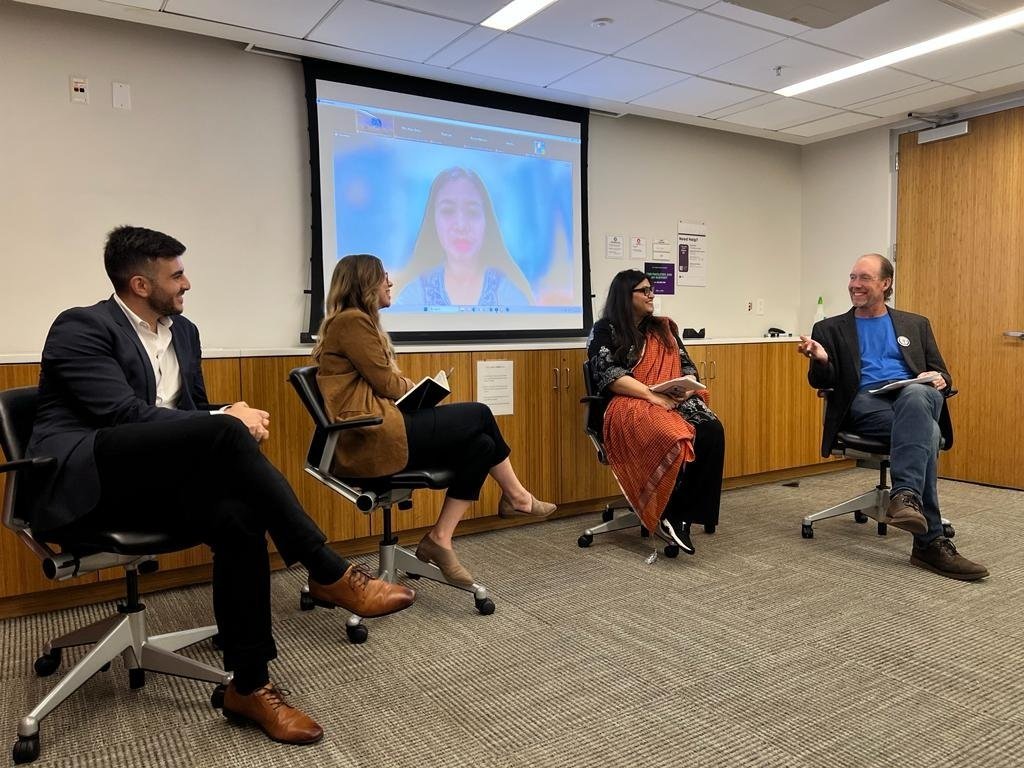
Reflections From The Field: Turning Decolonization Rhetoric into Action
PREP’s Reflection From The Field series started fourteen years ago as the first students in the Workshop in Applied Peacebuilding came back from their summer consultancies. Every year, students share their experiences working with local organizations and reflect on the work they have accomplished with them. The students panel was followed by a practioners panel and a reception.
On the theme of Turning Decolinization Rhetoric Into Action, students shared the practical steps they have taken before and during their consultancies to avoid replicating some of the paterns they have been learning about and ‘do no harm’. A recurent topic in the conversation was the ability to listen to the others and learn from them while conducting the different projects. Whether they were in Sri Lanka, Tunisia, Liberia, Jordan, or Iraq, students all agreed on the necessity for more localized peacebuilding which centers more on people than project.
After the students panel, Gulalai Ismail (Aware Girls Pakistan), Tala Bautista (Coffee for Peace), Grace Boone (CDA Collaborative Learning Projects) and Vahe Mirikan (Peace Direct) took the stage for a discussion moderated by Professor Thomas Hill. The practioners shared their organization’s approach to decolonizing peacebuilding. Funding was an important topic of conversation, and Gulalai argued that peacebuilding needs to reflect the needs of the communities rather than respond to funding opportunities. Indeed, Tala explained that understanding what peace means for the community by asking them is a necessary step to peacebuilding which generates rich answers that are not the text book. Both Gulalai and Tala insisted on accountability towards the communities rather than solely towards the donors and the importance of not getting trapped in one or two years projects. A language shift that was deemed necessary by all panelists was replacing the terms ‘recipients’ and ‘beneficiaries’ with ‘partners’, which they all do in their organizations.
On the relationship between CDA Collaborative and its partner organizations, Grace told the audience that these must be rooted in asking questions to be led by contextually grounded knowledge. While Vahe recognized the difficulty of changing funding culture, he explained that Peace Direct tries to push back on donors rather than communities, by shifting the funding model and transforming partnership reporting. Both Grace and Vahe insisted on redefining who is the expert and co-authoring with community members. Grace and Vahe also recognized the existing push backs around the term decolonization, and explained that it is sometimes more efficient to use other words such as localization with donors.
A conclusion that emerged from both panels was the importance of relationships in peacebuilding work and the necessity to enter into partnerships where learning and listening are central.

Peacebuilding in Our City x Pursuing Peace Through Justice
PREP’s Peacebuilding Our City seminar series emerged from the recognition of the clear peacebuilding deficits in the United States and a desire to acknowledge and learn from people doing phenomenal work at the community level to address those needs. Sam Adler from New York Peace Institute (NYPI) and Keli Young from VOCAL-NY joined us for our final event of the academic year to discuss how their organizations operationalize their strategic initiatives and advocate for justice within an often unsympathetic political system.
The New York City budget was an important topic of conversation, and both Sam and Keli weighed in on how their organizations address diminishing investment in community services while the budget of the NYPD balloons to $11B. VOCAL-NY plays an “inside-outside” game, educating communities on the city budget and how it is spent and then informing elected officials on what their constituents actually say is doing to make their communities feel safer. Sam agreed that “endless grassroots organizing and being involved in local politics,” is essential to instigate a shift in budget priorities.
Despite the fatigue that being in a “crisis mentality” might bring, Keli urged that it was essential to acknowledge that New York City is in a state of emergency – of homelessness, drug addiction, mass incarceration, HIV/AIDS, etc. – in order to effectively address these intersecting crises. With this acknowledgement, the root causes of these issues can be identified and addressed through means that actually make our communities more safe, such as through the mediation services NYPI provides. According to Keli, “safety is created through civility – through housing, through healthcare, through education,” and we need to reorient the city government to acknowledge the root causes of these crises and put resources into the solutions, not into the NYPD.
Rewatch the conversation here!

Decolonization in Action: Walking the Walk with PREP’s Partners
To celebrate the fifth anniversary of PREP, Director Thomas Hill and Deputy Director Katerina Siira invited partners from Colombia and Libya to join a conversation on the global discourse on decolonization and localization. Malki Elkibir, the Peacebuilding Program Manager at Moomken in Libya, and Yessica Tatiana Motta Galindo, the VP of FUNRESURPAZ in Colombia, shared their insights and reflections on PREP’s largest and longest-running project to date: Municipal Leaders Building Peace: Understanding Locally-Led Impact in Conflict-Affected Countries.
Despite the decades-long discourse and global recognition for the need to localize and decolonize peacebuilding, human rights, and development work, a lot of what has been done is not effective, either perpetuating harm or not doing enough to mitigate the harmful legacies and structures of colonialism. For instance, Malik noted that while Libya has seen huge investment in the 12 years following the revolution, international donors haven’t asked what people need and are instead focusing on the wrong thing. International civil society and donors want to help Libya become a democracy, but they have neglected to think about or develop tools to prevent election violence that may happen during this transition. While the priority of local communities is to help Libyan people protect themselves from the violence surrounding the election, focusing on enhancing social cohesion to make communities strong, this has largely been overlooked by the international community.
Yessica added her input on how participatory action research (PAR), an approach that is utilized by PREP and its partners, can help us to overcome the issues that Malik described. According to Yessica, PAR is “una metodología que apunta a la producción de un conocimiento propositivo y transformador mediante procesos de debate, de reflexión, y de construcción colectiva” – a methodology that aims at the production of purposeful and transformative knowledge through processes of debate, reflection, and collective construction. Through PAR, PREP and FUNRESURPAZ fully engages with the communities they are investigating, taking into account the realities of the community and the different views of all the local actors to allow for the possibility of “aprendizaje mutuo” – mutual learning – that results in more effective interventions as well as the empowerment of the community. The purpose of this research is “se pone al servicio de la comunidad y con esto ayudará a resolver sus problemas y necesidades y por supuesto a poder planificar sus proyectos futuros,” – to put it at the service of the community and with this it will help to solve their problems and needs and of course to be able to plan their future projects.
Finally, both Yessica and Malik reflected on the role of international partners, specifically universities, in localization and decolonization. Malik stated that “the role of the university now is to change the routine of our way of thinking,” and shared how Moomken’s partnership with PREP had introduced the organization to PAR and encouraged them to work with more diverse local actors, rather than actors they already knew, in order to create sustainable peace. Yessica shared that the key role of international university researchers is to embrace, engage, and comprehend the reality of each community so that they can start to transform and disrupt the power hierarchies together.
Rewatch this important conversation on Youtube.

Peacebuilding in Our City x Education
80% of Black trans and queer youth are depressed, 43% are harassed in schools, and less than 25% report receiving positive messages about their identities in school. While it is important to talk about the harm and violence that Black trans and queer youth face, Dr. Shamari K Reid reminds us that it is dangerous to present their lives solely as tragedies that are characterized by victimhood. We need to invert the narratives around marginalized groups and start to think about them as “people with agency, who have insight, and who know a lot about worldmaking, who know a lot about peace, who know a lot about love, and a lot about joy.”
An Assistant Professor in the Department of Teaching and Learning at NYU Steinhardt, Dr. Reid’s work explores how Black trans and queer youth and their communities sustain themselves amidst the oppression and violence. He studies NYC ballroom culture, a space where Black and Brown queer and trans folk have built a world where they are not just accepted, but affirmed and loved for being themselves.
Dr. Reid asks: What can traditional educators learn from this space? How can they transform schools into sites of equitable opportunities for Black LGBTQ+ youth?
He has recently published two articles - “Using a Queer of Color Critique to work toward a Black LGBTQ+ inclusive K-12 Curriculum” and “Exploring the Agency of Black LGBTQ+ Youth in Schools and in NYC’s Ballroom Culture,” and - in which he “translates” what he has witnessed from ballroom culture and offers guidance for educators on how to make schools more warm and welcoming for Black trans and queer students.
When asked about his definition of peace, Dr. Reid responded, “being able to wake up and go throughout your day in your full authenticity, as your full self and not having any fear about what might not happen to you.” Although this is not true right now in education for young Black queer and trans folk, he hopes that his work will push us all to construct places and spaces that are more peaceful for them.
Watch the event here!

Peacebuilding in Our City x Environment
Vijayta Narang, an alumna of NYU SPS's Global Affairs M.Sc. program, returned to Woolworth to speak about her experience working at CIV:LAB, an innovative grant-making network that channels funds and resources directly to community climate initiatives. She presented on CIV:LAB’s recent initiatives, including The Grid, the NYC Response Lab, and the Climate:Lab. Vijayta also discussed how she has applied peacebuilding theory and principles in climate action funding – a context that does not conventionally intersect with the field.
CIV:LAB’s core mandate is to act as bridge builders in the urban tech and innovation space in New York City. Vijayata discovered that much of CIV:LAB’s work was, unintentionally and unknowingly, rooted in peacebuilding theory. In her work as Program Director, she recognized elements of Lederach’s web theory – which emphasizes understanding social geography, finding the location of intersections, and being “smart flexible” – and his yeast theory, which asks who, rather than how many, it takes to start a movement.
If you missed this exciting conversation, you can watch it here!
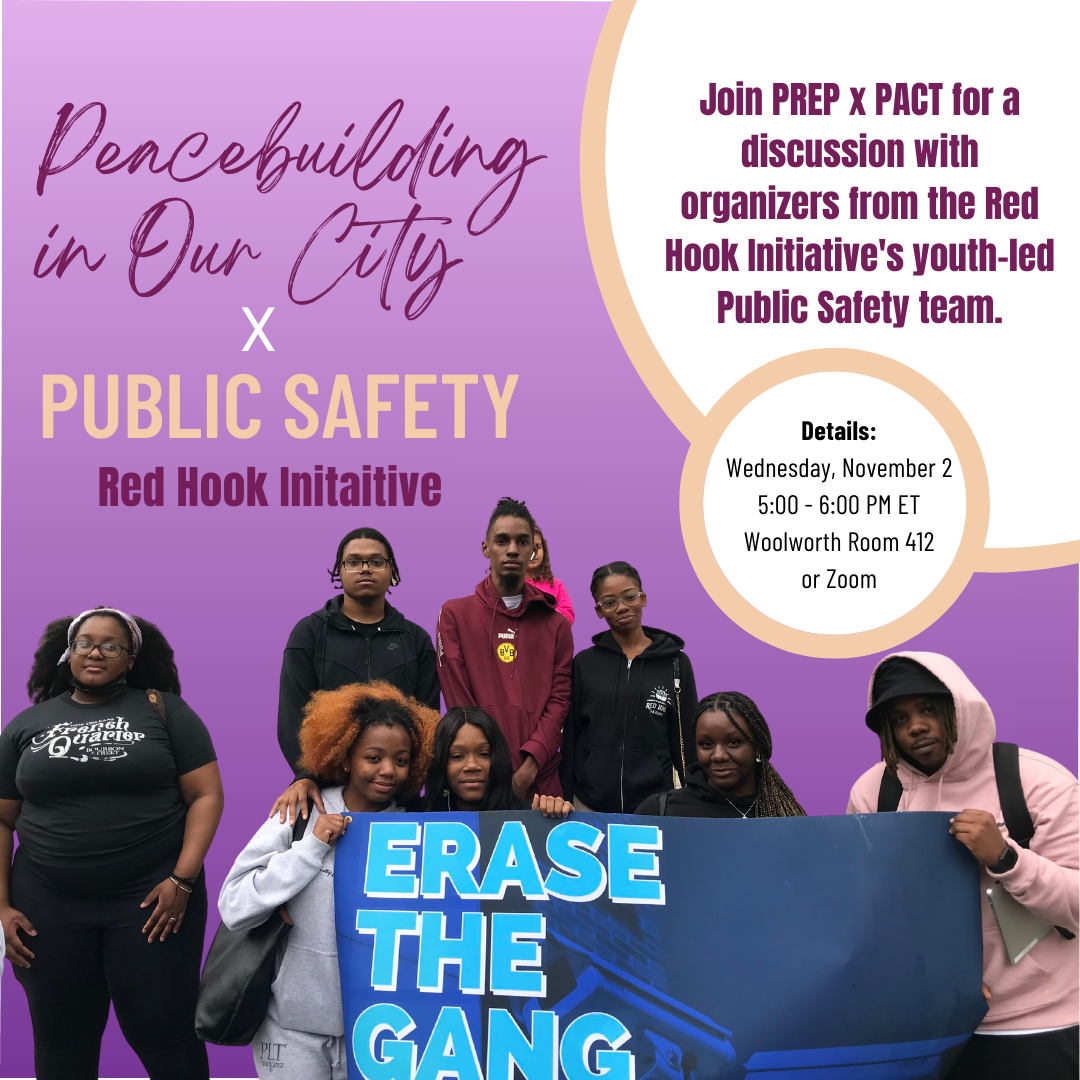
Peacebuilding in Our City x Public Safety
Organizers from Red Hook Initiative’s (RHI) Public Safety Team joined PREP to kick off this year’s seminar series: Peacebuilding in Our City.
Obi Afriye, a Public Safety Organizer at RHI, and An Doc, a member of the public safety team, provided an overview of the origins and goals of RHI’s Public Safety Program and shared their personal opinions on what a safe Red Hook would look like. They reflected on how our perception of public safety is influenced by our identity and encouraged seminar participants to consider what or who makes them feel safe, or unsafe, and why.
You can read more about RHI’s Public Safety program here, and check out their ethnography project cataloging organizers’ perceptions of public safety here.

Reflections from the Field
Back from their Workshop in Applied Peacebuilding summer consultancies, MSGA students Anjali Tallapragada, Pia Madanes Quintanilla, and Stevie Robinson gathered at the Center for Global Affairs to discuss their experiences working with local organizations in Uganda, Jordan, and Sri Lanka. They reflected on their role as outsiders and the challenges they faced as international peacebuilders.
The student conversation was followed by a panel of professional peacebuilding practitioners that included Liz Hume, the Executive Director of Alliance for Peacebuilding, Isabella Cuomo, the Executive Director at Build A Movement, and Eyako Heh, a Senior Research Specialist at Princeton’s Bridging Divides Initiative. Liz, Isabella, and Eyako joined PREP Director Thomas Hill to continue the discussion on the tension between domestic and international peacebuilding and offer their unique perspectives on the challenges of peacebuilding work in the United States.
If you missed it, watch the event here!
Bringing Peacebuilding (Back) into Your Career
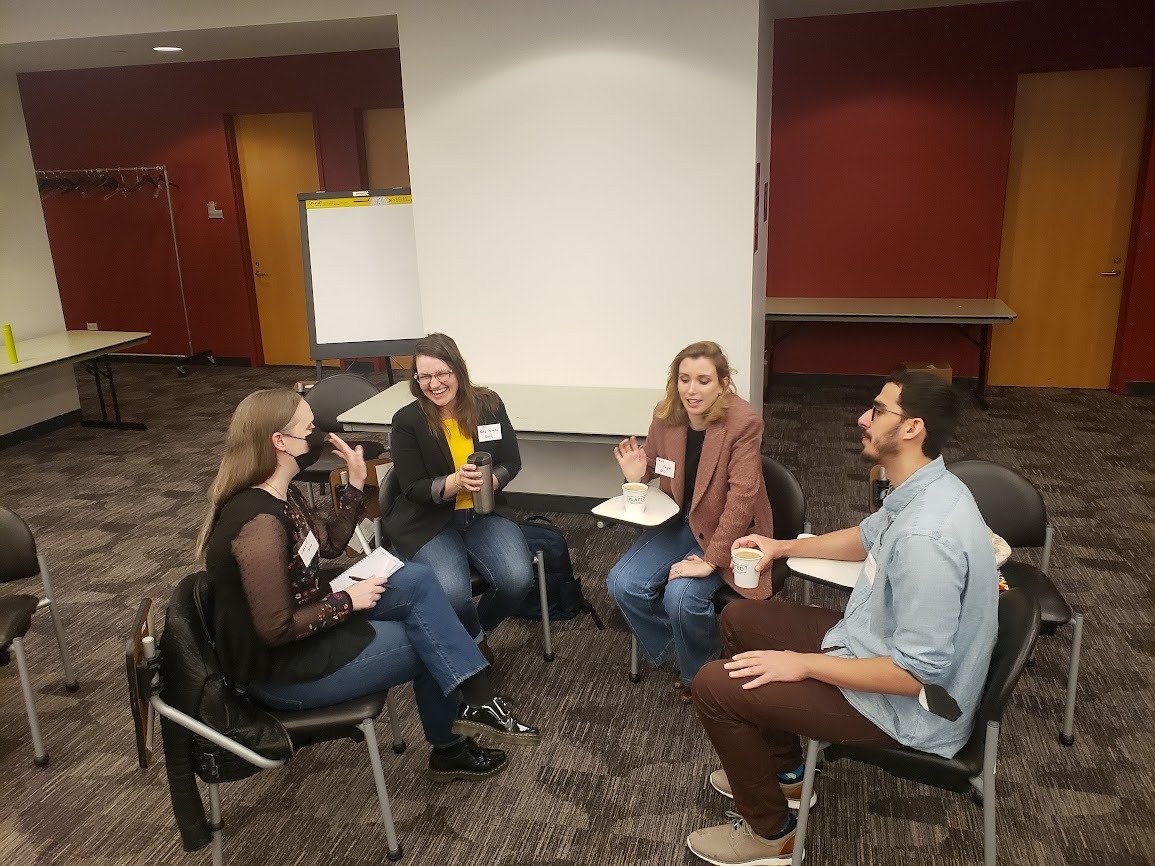
Approximately two dozen alumni of the Workshop in Applied Peacebuilding returned to The Woolworth Building for a day of reflection and celebration of the end of the popular course’s first decade. Marcus Lenzen, Senior Adviser and Deputy Chief of the United Nations Peacebuilding Fund, offered a keynote address.

The Basics of Trauma Literacy and Resilience Building
Lu Hanessian returned to offer a virtual experiential workshop via Zoom for an audience mostly composed of MSGA students that aimed to help them recognize the signs of trauma in themselves and others and to raise awareness of practices that promote resilience. Attendees learned about the different types of trauma and learn about how trauma awareness and knowledge can serve as a buffer against burnout, vicarious trauma, and sometimes PTSD.
HOW CAN MENTAL HEALTH AND PSYCHOSOCIAL SUPPORT PROGRAMS ADVANCE PEACEBUILDING IN IRAQ?
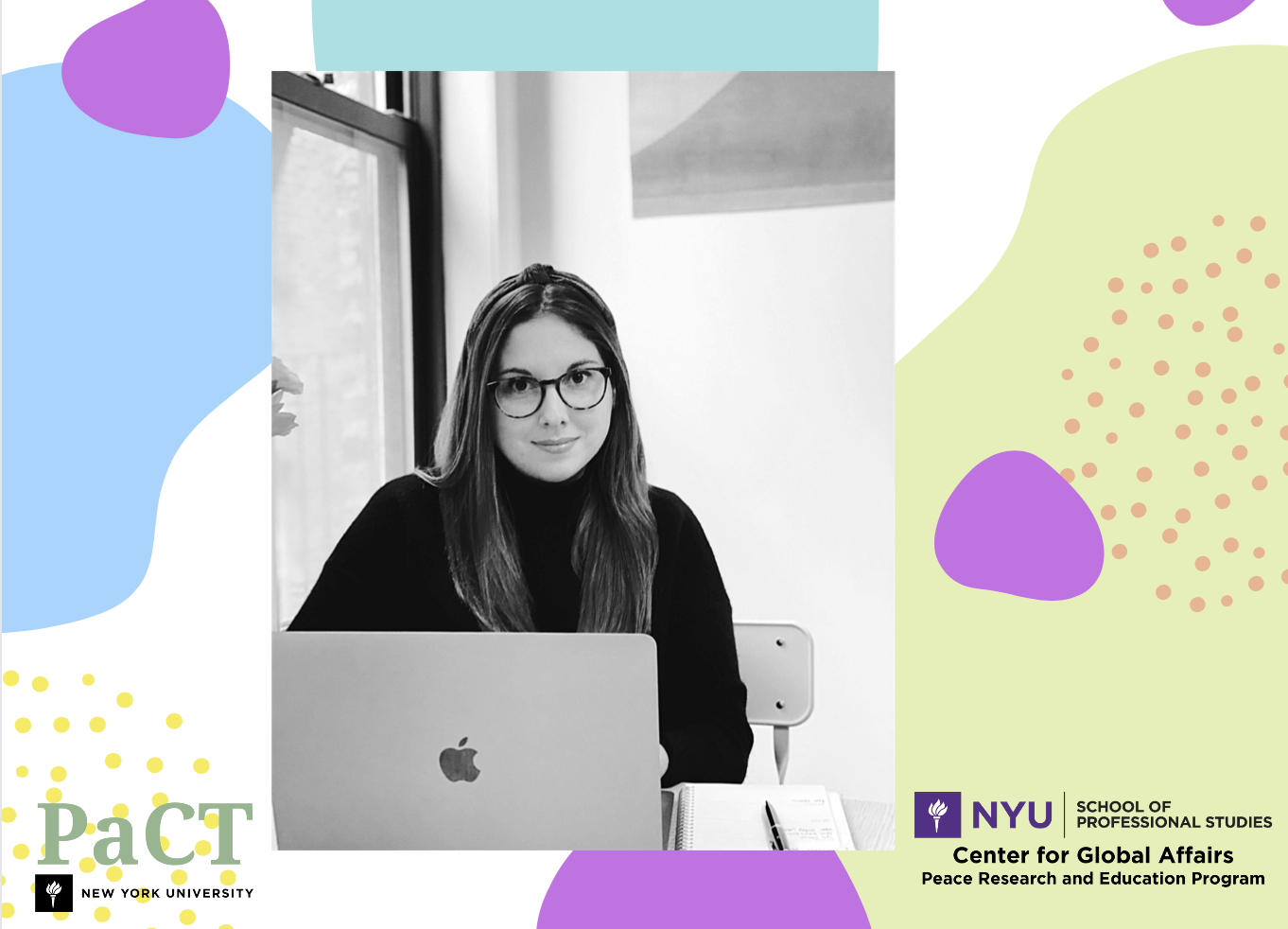
As part of PREP and PACT’s seminar series on peacebuilding and mental health MSGA Alumna Julie Meier joined a live audience at The Woolworth Building via Zoom to speak about her work managing mental health and psychosocial support programs for the International Organization for Migration in Iraq.
Peacebuilding Begins with Self-Awareness: Exploring and Recognizing Stress
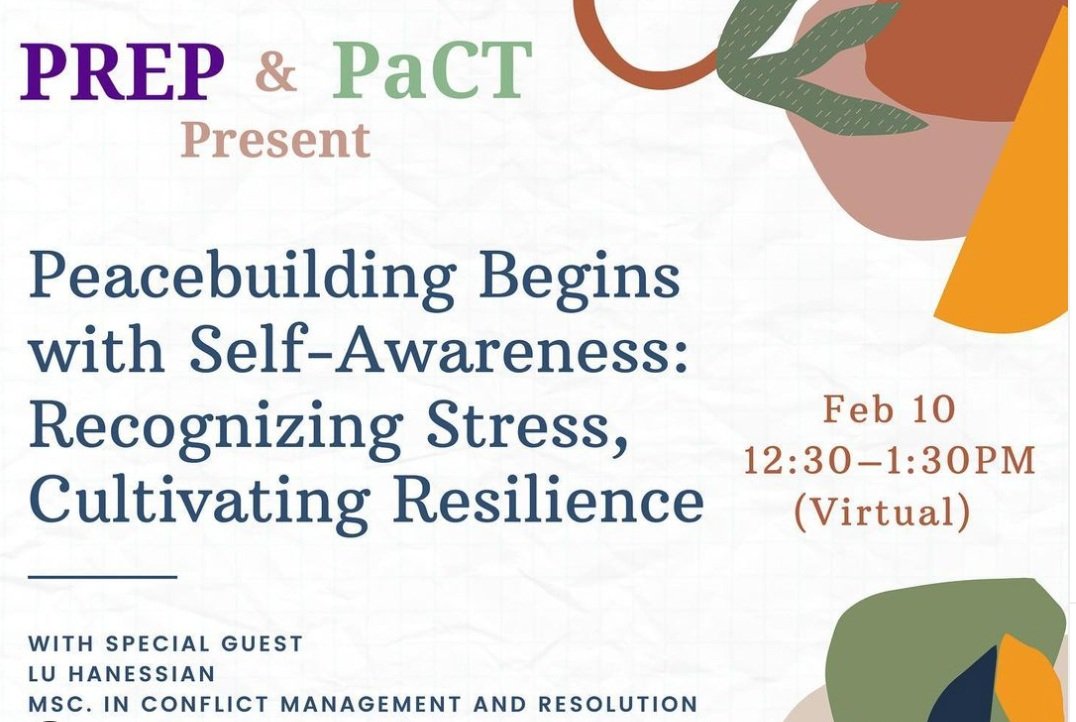
In collaboration with the Peace and Conflict Transformation (PACT) students at the Center for Global Affairs, PREP co-launched a series of events exploring how effective peacebuilding and fieldwork anywhere in the world begins right now with ourselves.
The first seminar in the series explored different kinds of stress, responses to stress, and the importance of self-awareness. Trauma and resilience researcher Lu Hanessian, MSc in Conflict Management and Resolution, spoke via Zoom with an audience of students and faculty about the biological basis of stress and the importance of self-awareness for peacebuilding and related fieldwork.
Lu is an adjunct professor of practice at the University of San Diego's School for Peace and Justice Studies, and Founder of Integrate Resilience, an award-winning journalist, neuroscience-based consultant, trauma and resilience researcher and educator, and host of the upcoming podcast "The Foreseeable Now."

Recovering Better for an Equitable and Sustainable World
PREP Director Thomas Hill gave a virtual presentation to a global audience convened by CETYS University in Mexicali, Mexico, intended to mark the International Day of Peace. He spoke about the importance of universities not only as academic spaces for the study of peace, but as influential institutional actors that can engage constructively with their surrounding communities to help build peace.
Reflections from the Field
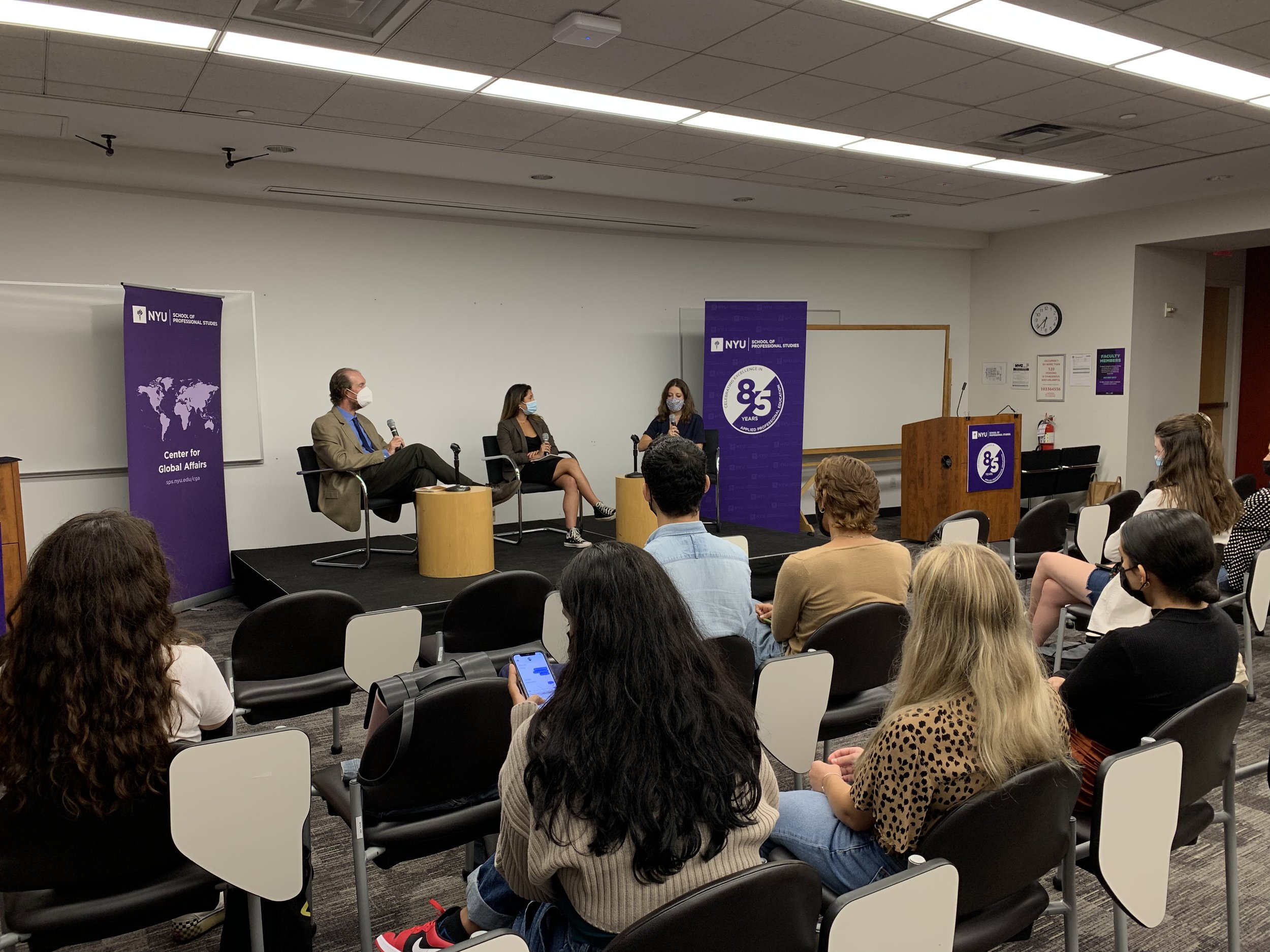
During PREP's first in-person event in more than 17 months, MSGA students Nikki Stoumen and Nada Elrhalami joined Professor Thomas Hill for a discussion about their summer experiences working as graduate student consultants for peacebuilding organizations in Iraq and Tunisia. They spoke about being part of the first wave of practitioners returning to international fieldwork as the COVID-19 pandemic began to subside as well as the challenges of entering a new world characterized by a blend of both in-person and remote peacebuilding work.
The Joint Research Seminar in Peacebuilding: Partnership through Mutual Inquiry
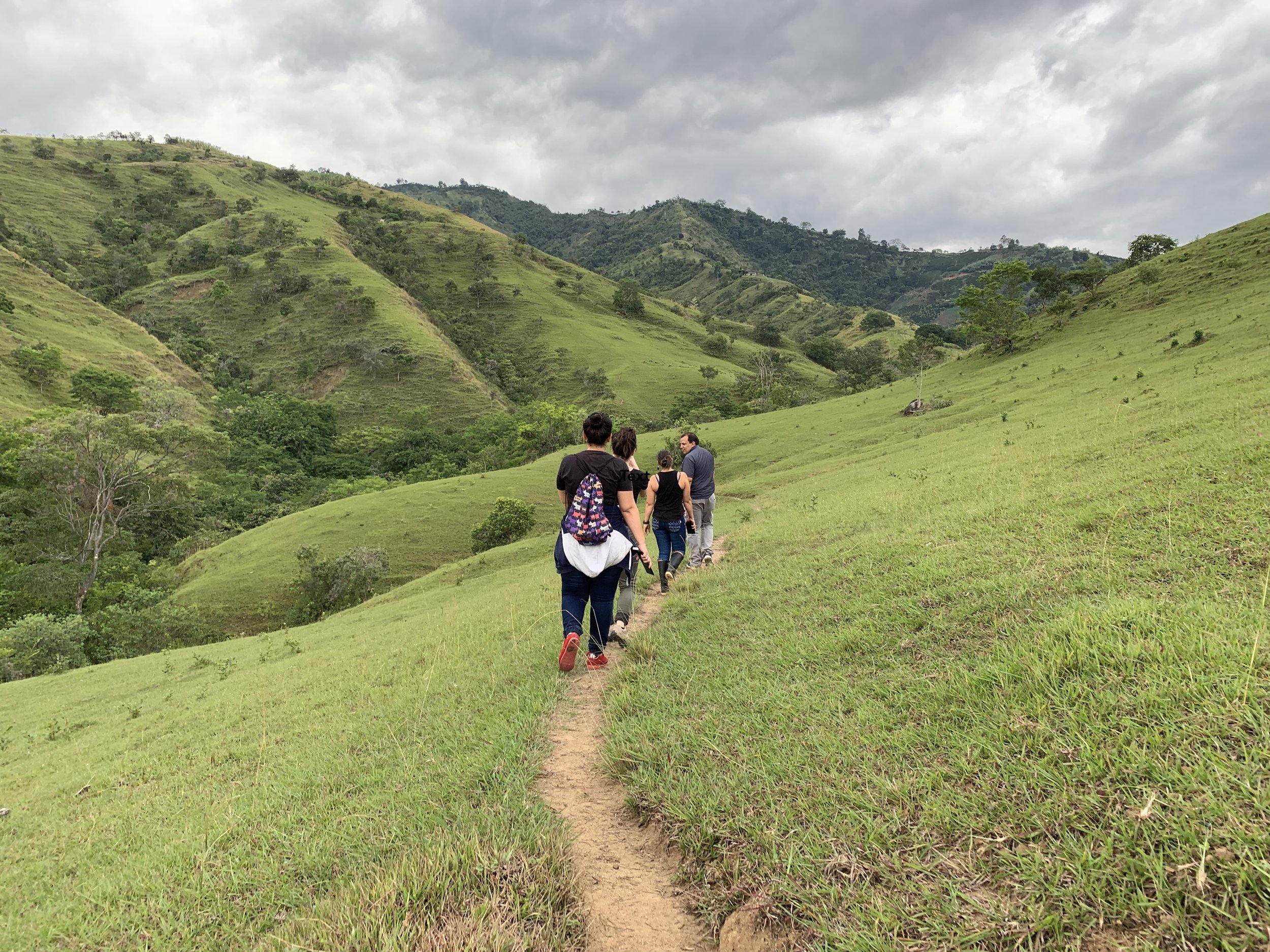
PREP Director Thomas Hill, Project Director Katerina Siira and MSGA Alumna Marta Bautista Forcada addressed an audience convened by the Colombian Studies Initiative at the NYU Center for Latin American and Caribbean Studies and Universidad de Rosario in Bogota. They spoke about the participatory action research that MSGA students have undertaken in Colombia through a partnership with the Escuela Superior de Administración Publica. They also reflected on the challenges of building equitable academic partnerships that draw on endogenous peacebuilding capacities as well as the successes of the collaboration with the Colombian students, who have transformed themselves from a student research group into an autonomous research organization known as FUNRESURPAZ.
BRIDGES TO PEACE AND DEVELOPMENT: A HOLIDAY DIALOGUE ACROSS FIELDS
Tuesday, December 10, 2024
4:00 PM 6:30 PM
NYU PREP is delighted to share the success of our event, "Bridges to Peace and Development: A Holiday Dialogue Across Fields”, on December 10, 2024. This engaging event brought together experts from the fields of peacebuilding and international development for a rich afternoon of conversation and networking.
Our esteemed panelists included Jonathan Cantres (Bard Early College High School), Sarah Gibbs (Center for Reproductive Rights), Marta Bautista Forcada (NYU Center on International Cooperation), Johan Fredborn Larsson (UNDP Conflict Prevention, Peacebuilding and Responsive Institutions Crisis Bureau), Katerina Siira (NYU Peace Research and Education Program), and Joy Galvez (UN Food and Agriculture Organization). Their diverse experiences provided invaluable insights into their work within international development, the United Nations, and broader peacebuilding initiatives.
The event's format encouraged interactive small-group discussions, fostering meaningful conversations between students and professionals. As Professor Hill remarked, "I felt such positive energy from all of you by the end of the event that I was convinced we may have just discovered the secret sauce for future career events: lots of interactive small-group conversations and zero time listening to a panel discussion."
We are grateful to all participants and guests for their engagement, thoughtful questions, and career insights. Special thanks to the DHA Club, PREP, and PaCT for co-hosting the event and making it such a memorable success. As we close out the semester, we look forward to continuing these important conversations and building stronger bridges between academia and practice in the new year.
FILM SCREENING AND DICUSSION: UNTOLD STORIES
Wednesday, February 5, 2025
5:00–7:00 PM
NYU PREP is pleased to reflect on the successful screening of Untold Stories, a powerful documentary directed by Dida Faridoon and presented in collaboration with Ideas Beyond Borders and the Kurdistan Information Network, with support from the Wikimedia Foundation Equity Knowledge Fund.
The screening offered a poignant exploration of Iraq’s marginalized communities, including the Kakayi, Feyli Kurds, Armenians, Assyrians, Chaldeans, Syriacs, Sabean-Mandeans, and Jews. Through compelling narratives, the documentary shed light on their histories, struggles, and resilience, fostering a deeper understanding of identity, migration, and democracy in Iraq.
Following the screening, attendees engaged in a thought-provoking Q&A session with Director Dida Faridoon, where powerful insights were shared about storytelling as a means of amplifying marginalized voices.
We extend our gratitude to everyone who participated in this impactful event, which highlighted the importance of preserving cultural narratives and promoting inclusivity through dialogue.
Flipping the Script: The Power of Nonviolent Action
Friday, September 9, 2024
6:00 PM 8:30 PM
NYU PREP had another successful event: "Flipping the Script: The Power of Nonviolent Action," hosted by NYU PREP at the start of the Fall semester.
The event featured two insightful panel discussions followed by a reception. The first panel showcased Master’s students from the Workshop in Applied Peacebuilding, who shared reflections from their summer consultancies in Sierra Leone, Jordan, and Libya. Their experiences provided valuable insights into the practical challenges and successes of peacebuilding efforts in diverse contexts.
The second panel brought together activists and practitioners from Combatants for Peace, Waging Nonviolence, and policy academics, who engaged in a compelling discussion about the role of strategic nonviolent action in driving social and political change. The panelists emphasized themes of adaptability, collaboration, and resilience in peacebuilding efforts.
We extend our sincere gratitude to all participants and contributors for fostering such a rich and meaningful dialogue. This event underscored the power of nonviolent action in creating lasting peace and strengthened our collective commitment to peacebuilding efforts worldwide.

Felis Conference in Chisinau
NYU PREP (Peace Research and Education Program) and Radical Flexibility Fund (RFF) collaborated with Genderdoc-M to host the Felis Conference in Chisinau, Moldova on April 12-13.
The conference was focused on discrimination of the LGBTQI community and named in honor of a trans young person who committed suicide in 2022 due to bullying. The collaboration with Genderdoc is part of a four-year project funded by the Department of State’s Bureau of Democracy, Human Rights and Labor which focuses on flexible and tailored support by NYU-PREP and RFF to civil society organizations in Colombia, Libya, and Moldova to develop their own definitions of impact on human rights, conflict prevention and building resilient societies.
The conference brought parents from across Europe together with policy-makers for the first time in the region to share their experiences advocating for their children. Part of the conference involved a series of research workshops with parents of LGTBQI children and trans youth to better understand their needs and definition of success on improving the human rights of marginalized communities in Moldova.

DOCUMENTARY FILM SCREENING:
NEW FACE OF SALONE
NYU PREP proudly hosted the successful screening of "The New Face of Salone" on March 15, 2024, at The King Juan Carlos I of Spain Center. This remarkable documentary offered a powerful cinematic journey into the heart of Sierra Leone, shedding light on its rich culture, untold stories, and the resilience of its people.
The event saw an overwhelming response, with 100 registrations and a full house. We were honored to welcome esteemed dignitaries, including ministers from Sierra Leone and UN officials, whose presence enriched the evening with invaluable insights.
Following the screening, a distinguished panel of ministers and diplomats from Sierra Leone engaged in a thought-provoking discussion, sharing reflections on the nation's journey and the government's aspirations for the future. The conversation was both inspiring and hopeful, leaving a lasting impression on attendees.
NYU PREP is proud to have showcased this impactful documentary and remains committed to fostering meaningful conversations and collaborations that promote understanding and empowerment. We look forward to continuing our partnership with the Ministry of Information and Civic Education of Sierra Leone in future initiatives.
A Courageous Conversations about Israel and Palestine
Wednesday, February 28, 2024
5:00 PM 7:00 PM
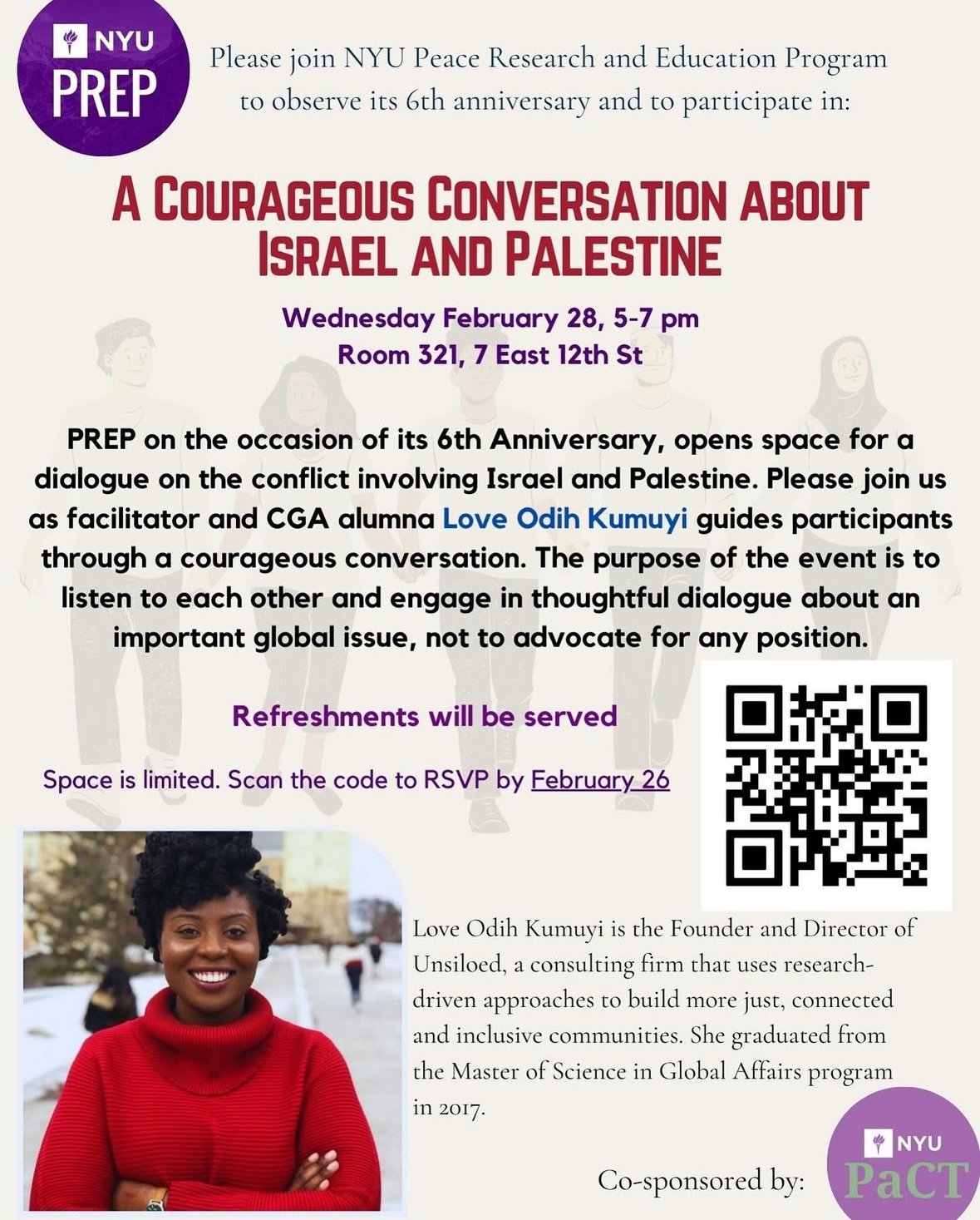
Following the events of October 7, 2023, many members of the NYU community and beyond found it challenging to engage in meaningful and productive conversations about the long-standing conflict between Israel and Palestine.
To address this, the Peace Research and Education Program (PREP) organized a facilitated dialogue titled “A Courageous Conversation about Israel and Palestine” on February 28, 2024, as part of its sixth-anniversary commemoration. The event was skillfully facilitated by CGA alumna Love Odih Kumuyi, founder of Unsiloed, who guided participants through a thoughtful and courageous conversation on this sensitive topic.
The dialogue created a space for participants to express their emotions, share their perspectives, and engage in meaningful conversation without advocating for specific positions. The event emphasized the importance of community involvement in navigating complex global issues and marked the beginning of ongoing conversations on challenging topics.
We extend our heartfelt gratitude to Love Odih Kumuyi for her invaluable facilitation and to all the participants who contributed to this important dialogue.